
Habitat & Conservation
|
06/11/2026
Learn and Burn in Ohio
Pheasants Forever and Quail Forever help local landowners learn about prescribed fire
by Gilbert Randolph, QF Regional Communications Specialist
Related Articles


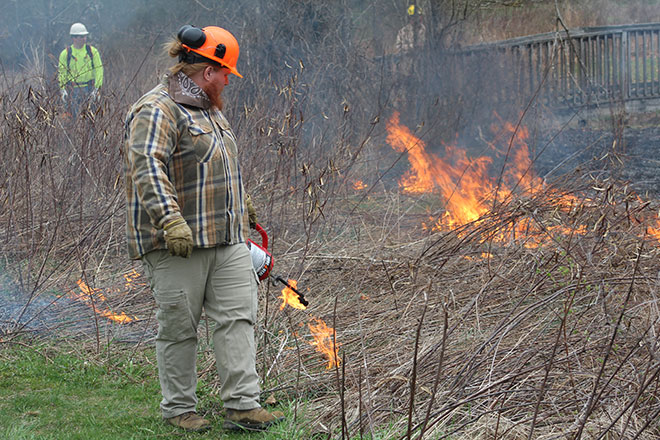
Pheasants Forever and Quail Forever recently assisted with a landowner workshop alongside the Ohio Federation of Soil and Water Conservation Districts, Ohio Division of Forestry and Ohio State University. The goal was to give people real, hands-on experience participating in a prescribed burn so they could develop and implement burn plans on their own properties.
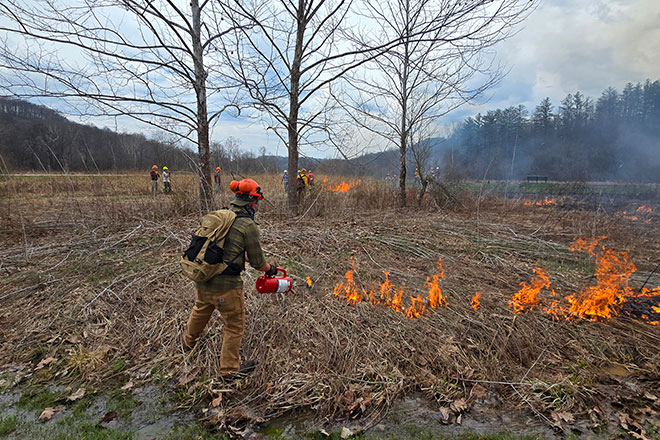
The workshop started with three in-person sessions covering the history of fire in Ohio, fire ecology and the nuts and bolts of how to conduct a safe burn. Next were four field days with live-fire burns and a session evaluating the effectiveness of the burns. As part of the field days, the workshop incorporated both a grassland burn and a woodland burn.
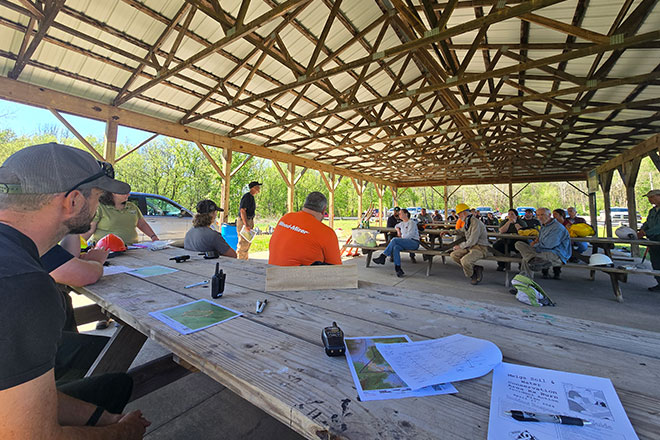
"Fire ecology and fire behavior are quite a bit different in oak-dominated forested areas with topography and elevation changes, versus native grasslands in flat bottomland. Having two separate burn days allowing participants to experience fire in both habitats was fantastic."
The burns were conducted on Meigs Conservation Area. Participants were able to see examples of preparing fire lines and learning how to use a drip torch, as well as anticipating landscape hazards and fire behavior.
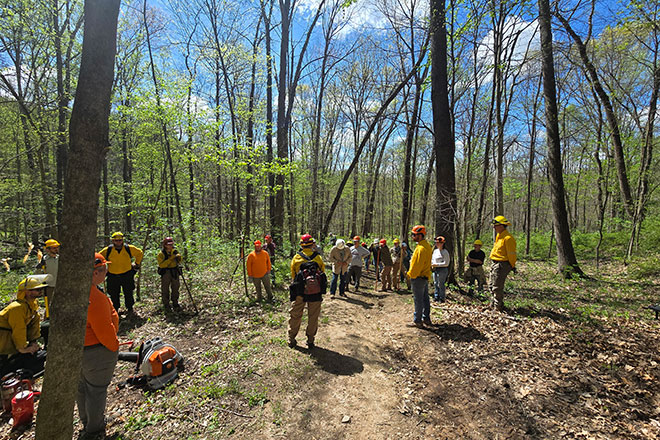
"The hands-on approach required more planning. However, it provided real-world scenarios which generated greater appreciation and caution for the practice. Ohio State University Extension's curriculum, which we used for the event, also brought a thorough and practical approach to teaching about prescribed burns."
The event was made possible by Meigs Soil and Water Conservation District, Vinton Soil and Water Conservation District, Athens Soil and Water Conservation District, Hocking College, Ohio State University Extension and the Ohio Division of Forestry. It also took place in a bobwhite quail priority geography for the United States Department of Agriculture's (USDA) Natural Resource Conservation Service (NRCS) Working Lands for Wildlife (WLFW).
The Working Lands for Wildlife partnership supports the USDA Natural Resources Conservation Service's premier approach for conserving America's working lands to benefit people, wildlife and rural communities. Simply put, WLFW aims to help landowners incorporate conservation into their agricultural operations in ways that benefit both wildlife and their bottom line.
Ohio landowners interested in participating in future Learn and Burn events should contact Jim Downs, field specialist and forestry assistant professor at Ohio State University Extension at downs.63@osu.edu.
Landowners are also encouraged to reach out to their local Soil and Water Conservation District, which offer additional access to training and equipment landowners can use to implement conservation work. Contacting an NRCS Service Center or a Pheasants Forever or Quail Forever biologist is another great way to learn more about what technical and financial assistance is available to integrate wildlife conservation into a land management plan.
Your cart is empty